
Knowledge
Start with what you are trying to figure out.
SOE knowledge is built around real founder problems - research, lived experience, frameworks, guides, questions and practical material that help make the next question clearer.
Browse by chapter
Go straight to the part of the work you are in.
The library
Useful before impressive.

Make Culture Portable: Turn Values Into Observable Decisions
Culture becomes fragile when it depends on the founder's personal presence and preferences.

Retention Is a Work-System Signal, Not Just an HR Metric
Retention can reveal problems in workload, autonomy, clarity, management and everyday work design.

Scale Quality: Define the Invariants Before Adding Volume
Scaling quality is an operating-system problem, not simply a hiring problem.

Pricing Tiers Should Clarify Choice, Not Hide Complexity
A tier should represent a meaningful buyer choice, not a longer feature list.

Name the Work Before You Name the Brand
Naming is easier when the underlying work is clear: customer, problem, category and promise.

Growth Strategy Starts With a Constraint, Not a Channel List
A list of channels is not a growth strategy unless it explains how each channel changes the current constraint.

Profitability Check: A Simple Founder Diagnostic
Profit is not the same thing as cash in the bank. Founders need a simple view of revenue, costs, contribution, and timing before using profitability as a decision signal.

When Team Energy Drops, Diagnose the Work Before the People
A drop in energy can reflect workload, mental load, unclear priorities, low autonomy or repeated friction.

Recover Clarity by Rewriting the Decision, Not the Mission
Strategic fog often comes from an unresolved choice rather than weak wording.

Build Authority by Making Proof Easy to Inspect
Authority claims become fragile when buyers cannot inspect the evidence behind them.
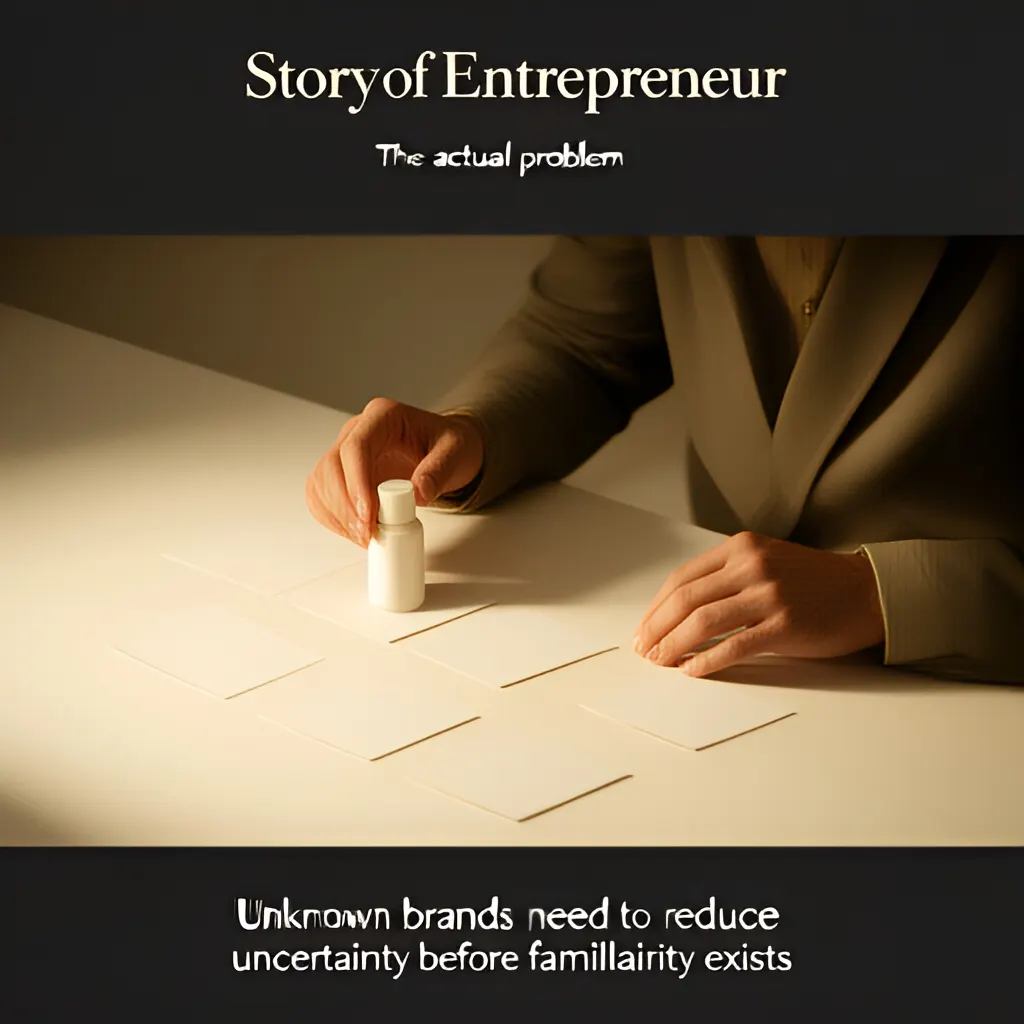
Trust Before Attention: Build Signals Buyers Can Verify
Unknown brands need to reduce uncertainty before familiarity exists.

Scale Capacity Before You Scale Volume
Demand can grow faster than delivery, cash, quality or management capacity.

How to Start Building Momentum When Everything Feels Like Too Much
Starting momentum comes from sequencing uncertainty, action and learning rather than trying to complete the whole business at once.

When Everything Is Important, Design a Decision Filter
Urgency without a filter turns the founder into the routing system for every request.

Discounts Need a Job: Decide What the Price Change Is Supposed to Buy
A discount without a defined purpose becomes permanent margin leakage.

How to Price the Outcome Without Guessing
Value pricing is a disciplined pricing method, not a permission to invent a high price from an attractive ROI story.

Negotiation Starts With Variables, Not a Lower Price
A buyer's price request can signal budget, risk, scope or timing—not necessarily a permanent price cut.

Audience Is Not a Pipeline: Decide What You Need First
Audience attention and customer demand are different signals. A large reach can coexist with weak fit or buying intent.

Raise Capital Only When the Next Milestone Can Be Measured
Capital is useful when it buys time to reach a measurable proof point, not when the amount itself becomes the milestone.

Build Momentum by Shrinking the Next Decision
Stalled work often contains an oversized question rather than a missing task.

Stop Chasing More Leads Until You Know Which Customers You Need
A weak customer-fit definition can make more leads a multiplier of the wrong problem.

Founder Exit Readiness: Can the Business Run Without You?
Founder dependency shows up when approvals, customer relationships and operating knowledge live mainly in one person.

How to Design Pricing Tiers That Help Buyers Choose
Tiered pricing is a packaging and decision-design system. The structure should clarify customer choice while protecting delivery economics.

What Evidence Says It Is Time to Launch Instead of Waiting?
Launch when the evidence needed for the next decision can only be collected through real use or purchase, and the remaining risk is acceptable for the stage.

What Should Be Ready in a Fundraising Data Room Before Investors Ask?
A fundraising data room should make ownership, financial performance, runway, legal structure and core business evidence easy to verify before investor diligence begins.

How to Use a Conditional Discount Without Teaching Buyers to Wait
Tie discounts to a genuine condition such as scope, timing, volume or a defined segment. Keep the standard price stable so the discount does not become the real anchor.

Are Preorders or Deposits Stronger Validation Than Survey Answers?
Preorders or deposits usually create stronger behavioral evidence of willingness to commit than survey answers, but they also test a more specific offer and audience.

How to Run Stay Interviews in a Small Company Without Making Them Performative
A useful stay interview asks what helps someone do good work, what makes the job harder than it needs to be, what could make them leave, and what the founder or manager can realistically change.

How to Quantify Customer Value Without Pretending the Number Is Precise
Estimate customer value using observable outcomes, relevant alternatives and reasonable ranges rather than pretending the number is exact. Value-based pricing is a decision model, not a license to invent a large figure.

When to Standardize an Offer Instead of Accepting More Custom Work
Standardize an offer when repeated customer work contains a stable core problem, repeatable delivery and enough demand to justify a clearer scope. Custom work remains useful when the business is still learning or the value genuinely varies materially.

How to Tell Whether a Performance Problem Is Coaching, Role Mismatch, or Termination
First diagnose whether expectations, capability, role design and support are aligned. The response may be coaching, redesign, reassignment or termination.

How to Use a Decision Memo When Every Option Looks Plausible
Use a short decision memo to make the choice explicit: the problem, evidence, alternatives, trade-offs, decision rule and what would change your mind.

How to Position Your Business So the Right Buyer Understands It
Positioning is not a clever tagline. It is a choice about the buyer, the alternative, the value that matters, and the proof that makes the claim believable.

How BATNA and a Reservation Point Keep Founders From Negotiating From Fear
Define the best realistic alternative and the point at which a deal becomes worse than that alternative before negotiating. This gives the founder a decision boundary instead of relying on pressure in the room.

How to Redesign a Founder Workload Before Burnout Becomes the Constraint
Redesign the founder workload around decision value, energy cost, delegation and repeatability before exhaustion becomes the operating model.

How Workload, Autonomy, and Clarity Affect Team Motivation
Team motivation is shaped by the work system as well as individual attitude. Examine workload, role clarity, decision autonomy and whether people can see how their work matters before defaulting to motivational speeches.

What Should a Founder Clarify Before Accepting an Earnout or Post-Sale Role?
Clarify what the founder must deliver, how performance is measured, who controls the relevant decisions, what happens when circumstances change, and how the founder's post-sale role ends.

How Should Founders Compare a Full Sale and Partial Liquidity Option?
Compare ownership transferred, cash received, retained upside, control, risk, tax and post-closing obligations. Partial liquidity and a full sale solve different founder problems.

How to Build Recurring Revenue That Is Worth Renewing
Recurring revenue is not created by choosing monthly billing. It comes from a customer relationship in which the continuing value is clear enough to justify continuing payment.

Contribution Margin vs Net Profit: What Each Tells a Founder
Contribution margin helps answer whether a sale or product contributes toward fixed costs and profit. Net profit answers what remains after the full expense structure. Founders need both because they describe different layers of the business.
Are Preorders or Deposits Stronger Validation Than Survey Answers?
Preorders or deposits usually create stronger behavioral evidence of willingness to commit than survey answers, but they also test a more specific offer and audience.

How to Test a Business Name Before Committing to the Brand
Test a name for distinctiveness, meaning, pronunciation, searchability and trademark risk before investing heavily in a brand system.

How Solo Founders Build a Support Network Before They Need One
Build a support network before a crisis by separating peer support, domain expertise, accountability, emotional support and professional advice rather than expecting one person to provide everything.

Feedback vs Performance Management: When They Are Not the Same Thing
Feedback is an ongoing learning mechanism. Performance management is a broader system for expectations, evidence, accountability and consequences. A company needs both and should not use one as a substitute for the other.
Contribution Margin vs Net Profit: What Each Tells a Founder
Contribution margin helps answer whether a sale or product contributes toward fixed costs and profit. Net profit answers what remains after the full expense structure. Founders need both because they describe different layers of the business.

What Should Success for a First Employee Look Like in 30, 60, and 90 Days?
A strong first-employee plan defines outcomes, ownership and learning milestones rather than a long task list.

How to Document Decisions So a Remote Team Does Not Need Another Meeting
Document decisions with the question, chosen option, owner, rationale, evidence and revisit condition so people can act without reconstructing the conversation.

When Recurring Revenue Should Not Mean a Subscription
Recurring revenue does not require turning every customer into a subscription. Retainers, maintenance, replenishment, usage-linked services and recurring contracts can fit when the customer has a recurring job to solve.

How to Diagnose a Stalled Sales Pipeline by Stage Instead of Rewriting Everything
Diagnose pipeline failure by stage. Find where prospects stop progressing, then test the specific assumption at that stage before rewriting the whole sales process.

How to Build Referrals Into a Customer Acquisition System Without Bribing Customers
Build referrals around a customer experience worth sharing, a clear moment when a referral is useful, and an easy path for the right customer to introduce the business. An incentive is not a substitute for customer value.

When Should You Use Good-Better-Best Instead of Modular Pricing?
Use Good-Better-Best when customers can meaningfully self-select across complete solution levels. Use modular pricing when customers need to assemble different capabilities or quantities.

How to Delegate Decisions Without Abdicating Responsibility
Delegate the decision authority, not the accountability. The founder should clarify the decision, boundary, information, escalation point and expected outcome before handing it over.
How BATNA and a Reservation Point Keep Founders From Negotiating From Fear
Define the best realistic alternative and the point at which a deal becomes worse than that alternative before negotiating. This gives the founder a decision boundary instead of relying on pressure in the room.

Cost-Plus vs Value-Based Pricing: What Each Method Is Actually Good For
Use cost-plus when cost visibility and a predictable markup solve a real commercial problem. Use value-based pricing when customer outcomes and alternatives provide enough evidence to estimate value. The methods answer different questions.

When Should a Founder Story Appear in a Sales Deck?
Use the founder story when it helps the buyer understand why the company sees the problem differently, why the approach exists, or why the team is credible for this specific problem.

How to Structure a First Salesperson's Compensation Without Making the Plan the Strategy
Design first-sales compensation around the learning stage of the company, the sales cycle, quality of revenue and what the salesperson can actually control.
How to Redesign a Founder Workload Before Burnout Becomes the Constraint
Redesign the founder workload around decision value, energy cost, delegation and repeatability before exhaustion becomes the operating model.
How to Position Your Business So the Right Buyer Understands It
Positioning is not a clever tagline. It is a choice about the buyer, the alternative, the value that matters, and the proof that makes the claim believable.

How to Build Strategy From Constraints Instead of Copying Competitors
Build strategy from the specific constraints and advantages your company has rather than copying the visible tactics of a competitor.
What Evidence Says It Is Time to Launch Instead of Waiting?
Launch when the evidence needed for the next decision can only be collected through real use or purchase, and the remaining risk is acceptable for the stage.