
Brand Trust Is Built Through Verifiable Signals
Trust grows when buyers can inspect what a company promises, proves, and delivers.
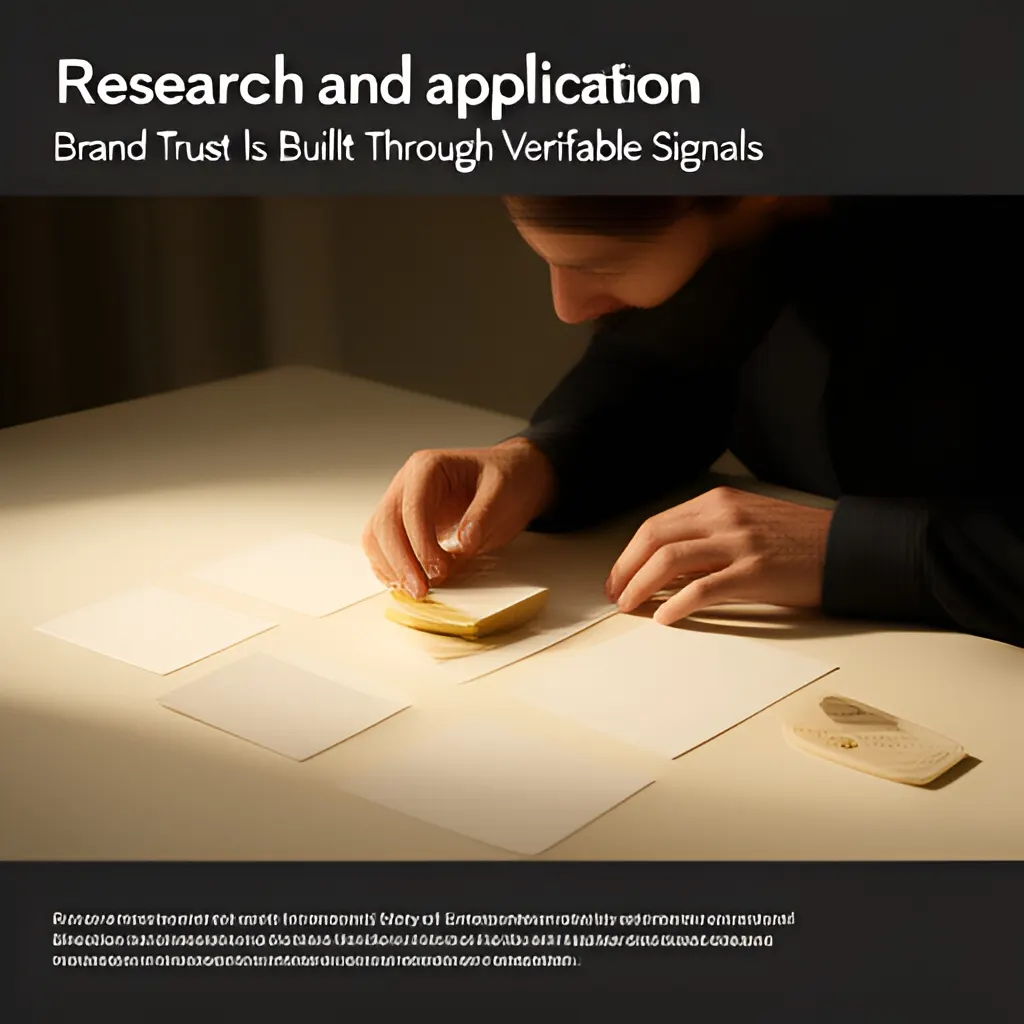
Brand trust grows when buyers can inspect the promise, evidence, process, and consistency behind a company.
In short
- • Specific claims are easier to evaluate.
- • Case studies are stronger when they explain work and constraints.
- • Reviews should represent genuine experience.
- • Operational consistency is part of brand trust.
Brand trust is built when a buyer can inspect the promise, evidence, process, and consistency behind a company. A new visual identity, more content, or more testimonials can help, but none creates trust by itself.
Start with a promise that can be checked
A trustworthy brand makes a claim with a clear boundary. Specificity gives the buyer something concrete to evaluate.
Show the work behind the claim
A useful case study explains the situation, work performed, relevant constraints, and change. If a claim cannot be supported by customer evidence, internal records, a clear method, or another appropriate source, narrow the claim. The Federal Trade Commission says advertising claims should be truthful, not deceptive or unfair, and evidence-based.
Treat reviews as evidence
Reviews matter because they are supposed to represent real customer experience. FTC guidance says businesses should not ask people who have not used a product or service for reviews and should not condition incentives on positive reviews.
Make the buying process predictable
Buyers notice whether pricing is understandable, response times are clear, deliverables are defined, and the company behaves consistently after payment.
Keep brand signals aligned
Trust falls when the website says one thing, sales promises another, proposals add hidden conditions, and support cannot explain what was sold. Keep a small set of operating truths and use them across the customer journey.
Build a proof inventory
Maintain verified outcomes, documented examples, demonstrations, methodology, qualifications, independent sources, customer feedback, policies, and clear constraints. Map each proof item to the uncertainty it reduces.
The decision
If your brand feels difficult to trust, do not begin by making it louder. Make it easier to verify. Narrow the promise. Show the work. Use genuine customer evidence. Make the buying process predictable. Keep claims consistent. Remove proof you cannot substantiate.
Research and application
Trust is easier to manage when the founder treats it as a verification problem rather than a volume problem.
The Federal Trade Commission's advertising guidance requires marketing claims to be truthful and appropriately substantiated. That means the practical question is not “How can we look more credible?” but “Which important claim can the buyer verify, and what evidence supports it?”
Build a proof map
For every material claim, record:
Claim → evidence → date → owner → limitation
Examples of evidence can include:
- documented customer outcomes;
- product demonstrations;
- methodology;
- relevant qualifications;
- independent research;
- clear policies;
- verified testimonials.
If the evidence does not support the full claim, narrow the claim.
Put proof where the decision happens
A case study hidden on a separate page is less useful when the buyer's uncertainty is on the pricing or product page.
Map each major uncertainty to the proof that addresses it.
Review the gap
Ask recent prospects:
- What made you hesitate?
- What did you need to verify?
- Which claim was unclear?
- What proof would have reduced the uncertainty?
Use the answers to improve the proof layer.
Trade-off
More proof can create confidence.
Too much proof can create noise.
The goal is not maximum evidence. It is sufficient, relevant and verifiable evidence at the point of decision.
Source note: Federal Trade Commission advertising guidance supports the substantiation principle; SOE adds the operational proof-map framework.
Take it into your work
Do something with what you just read.
Save it for later, mark the passage that matters, or open your SOE workspace and keep thinking.
Takeaways
What to carry forward
- → Bound the promise.
- → Show verifiable proof.
- → Use genuine customer evidence.
- → Keep operations consistent.
A strong brand gives the buyer a clear path to believing what is true.